
TL;DR. Client-side rendering ships a near-empty HTML shell and lets JavaScript build the actual page content inside the browser after it loads. 73 percent of websites using client-side rendering experience significant indexing delays compared to server-rendered equivalents, since search crawlers have to wait for a separate rendering pass before that content becomes visible to them at all.
What is client-side rendering?
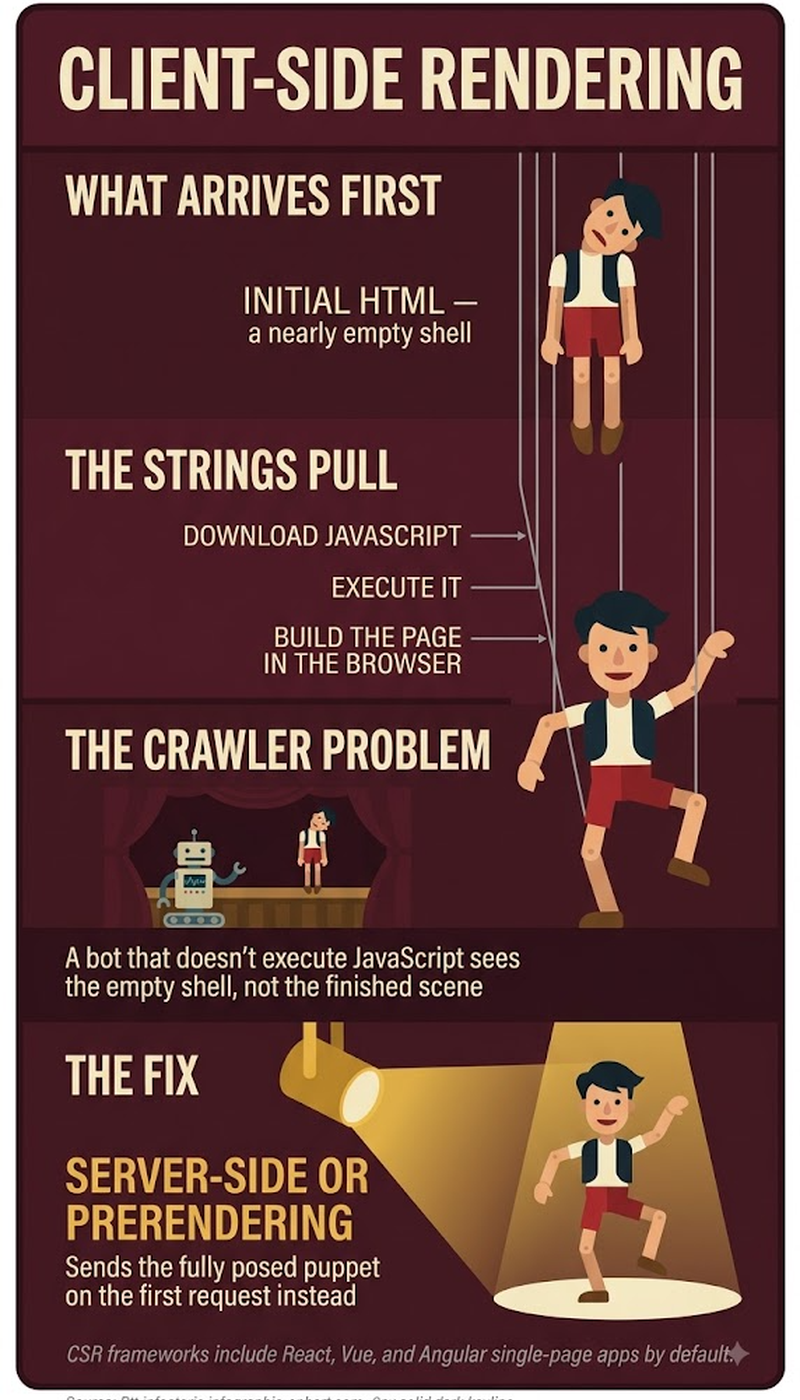
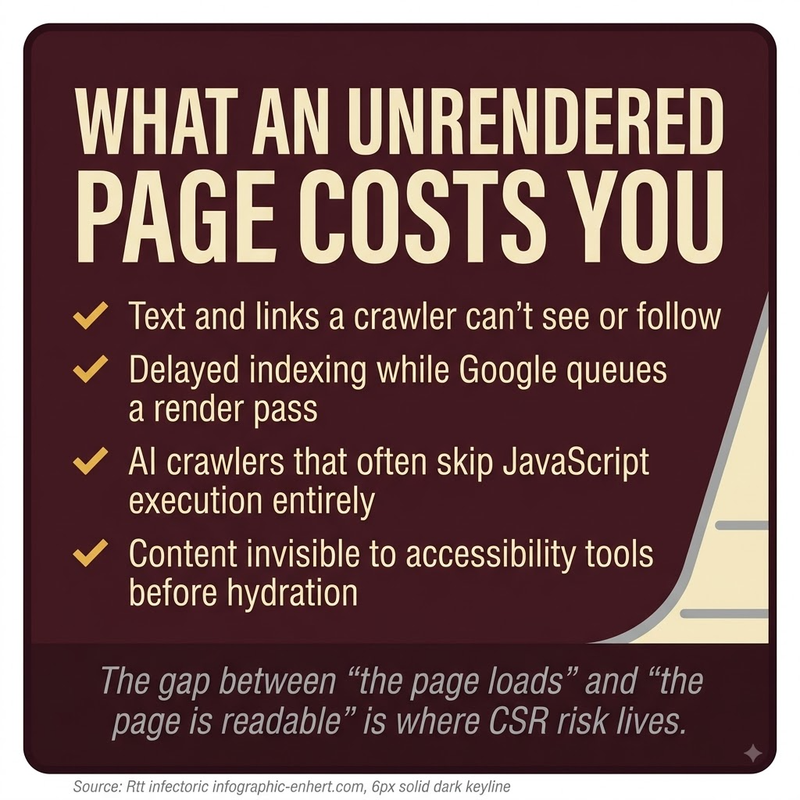
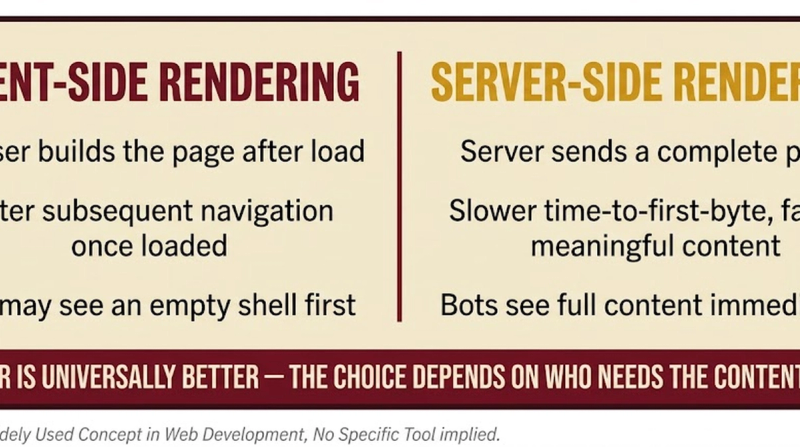
Client-side rendering sends the browser a minimal HTML document, often little more than a single div and a script tag, and relies entirely on JavaScript running in the browser to fetch data and construct the visible page. A human visitor with JavaScript enabled sees this happen almost instantly on a fast connection; a search crawler sees an empty shell until it separately executes that same JavaScript, which is exactly where CSR's SEO risk comes from.
Key highlights
- 73 percent of CSR sites experience significant indexing delays relative to server-rendered counterparts, a gap traced directly to Google's separate, queued rendering pass for JavaScript-dependent content.
- E-commerce sites have documented real revenue loss from CSR product pages taking days to appear in Google Shopping, a delay that vanished once the same pages moved to server-side rendering.
- A pure CSR single-page app depends entirely on Google's render queue for every route, with no fallback if that queue is slow or a render attempt fails silently.
Where CSR still makes sense
CSR remains a reasonable fit for content that doesn't need to rank at all, an authenticated dashboard, an internal admin tool, or a highly interactive feature behind a login wall where search visibility was never a goal. The risk is specifically concentrated in public, indexable routes, product pages, blog posts, category pages, that CSR leaves dependent on a rendering queue outside the site's own control.
Moving off CSR without a full rewrite
- Identify which routes actually need to rank in search, since not every route on a CSR app requires a rendering fix.
- Convert just those routes to server-side rendering or static generation, leaving interactive, non-indexable routes on CSR.
- Verify the fix with Search Console's URL Inspection tool, comparing the crawled HTML against what a real browser renders.
Frequently asked questions
Does Google index client-side rendered content at all?
Yes, usually eventually, through its separate JavaScript rendering pass. The problem is timing and reliability, not a flat inability to process it.
Is CSR ever the right choice for a public-facing page?
Rarely, for anything meant to rank. Even highly interactive public pages generally benefit from shipping meaningful content in the initial HTML and layering interactivity on top, which is closer to a hydration pattern than pure CSR.
What's the fastest way to check if a page is client-side rendered?
View the page's raw HTML source directly, before JavaScript executes; if the main content is missing and only a script tag and empty containers are present, the page is relying on client-side rendering.


