
Render budget is an industry-coined term, not an official Google concept, describing the limited computational resources and time Googlebot allocates to rendering a page's JavaScript. It's drawn as a direct analogy to Google's own, officially documented concept of crawl budget. Google has publicly described JavaScript-heavy pages going through a "second wave of indexing," where the initial HTML is crawled first and JavaScript execution happens later, resource capacity permitting. SEO practitioners started calling that separate, JavaScript-specific resource allocation a "render budget," building on Google's crawl budget language even though Google itself hasn't formally adopted that exact term.
Key Takeaways
- Render budget isn't an official Google term the way crawl budget is — it's an industry analogy built on Google's documented "second wave of indexing" concept for JavaScript-heavy pages.
- Google processes a page's raw HTML first, then defers JavaScript rendering to a later stage when computational resources allow. JavaScript-dependent content can take meaningfully longer to be discovered and indexed than static HTML content.
- Content that isn't rendered is effectively invisible to search engines. A link, a piece of text, or a whole section that only appears after JavaScript execution can be missed entirely, if rendering doesn't happen or gets delayed.
- Render budget concerns apply specifically to JavaScript-heavy, client-side-rendered sites — a site relying primarily on static HTML doesn't face this particular resource constraint.
- There is minimal measurable current search volume for this term beyond the base phrase itself — it's covered here for concept completeness on a real, if under-searched, technical SEO topic.
Render budget sits directly alongside crawl budget as a related but distinct resource constraint, and both connect to JavaScript SEO as the broader discipline addressing how JavaScript-dependent sites need to be built for reliable search visibility. Dynamic rendering is one specific (though now discouraged) workaround some sites have used to sidestep render budget concerns entirely.
Why Does JavaScript Rendering Require a Separate "Budget" From Crawling at All?
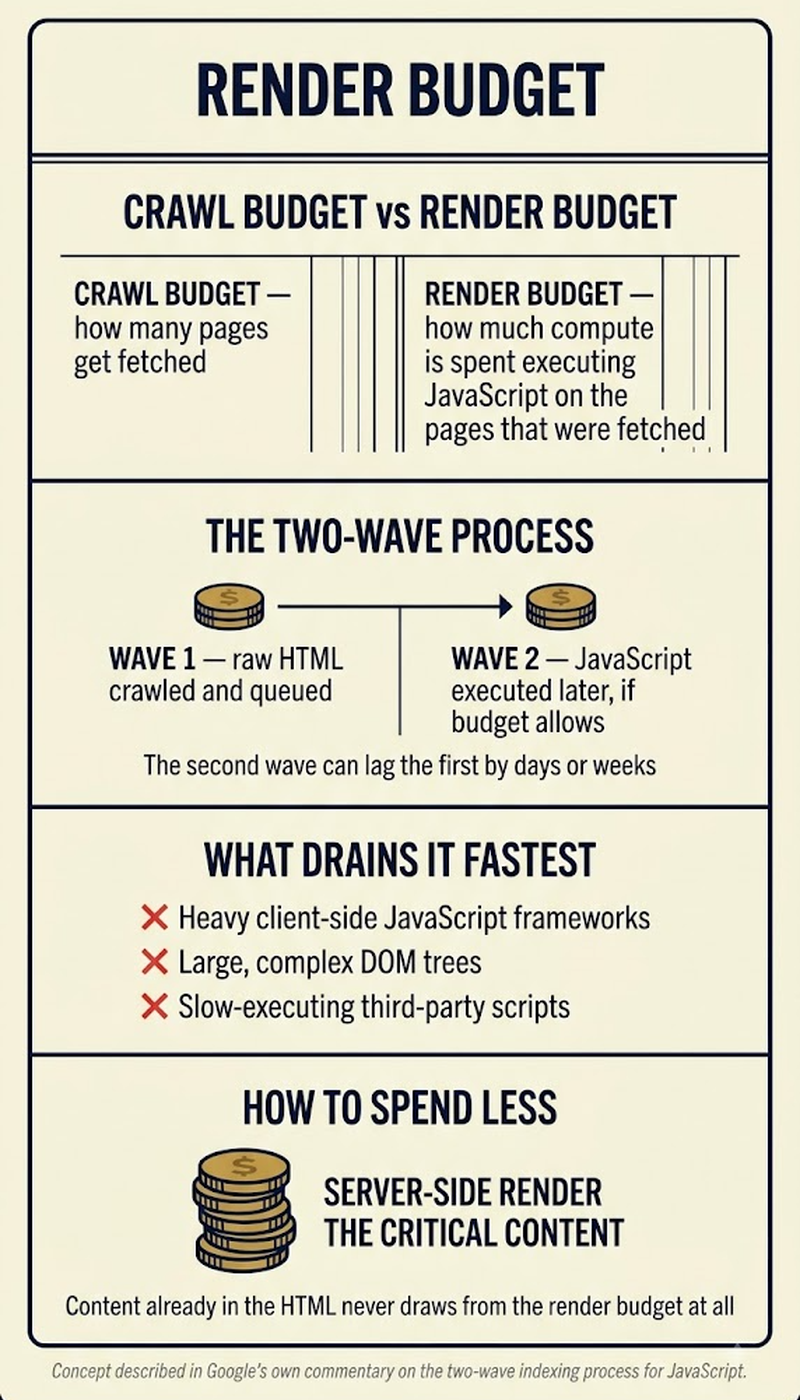
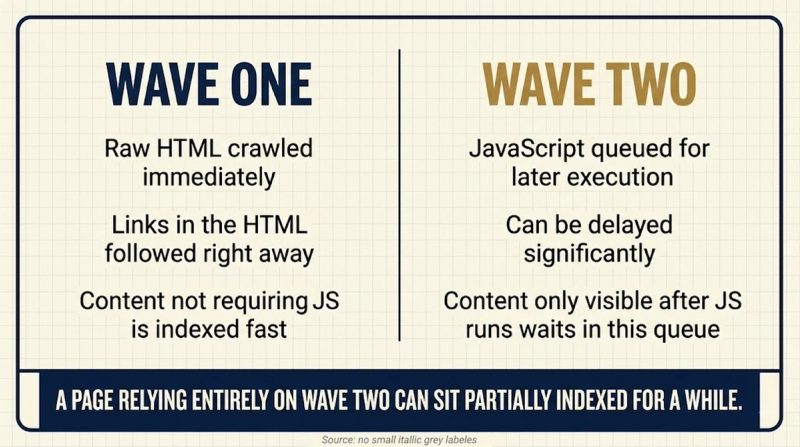
Rendering JavaScript is computationally far more expensive for Google than simply crawling static HTML. Rendering requires actually executing code in a headless browser environment to see what a page looks like after JavaScript runs, a fundamentally more resource-intensive process than reading and parsing plain HTML text. Google has described this as a "second wave of indexing": Googlebot first crawls and indexes the raw HTML a server returns, then separately queues the page for JavaScript rendering, which happens later once rendering resources become available. This two-stage process is exactly why JavaScript-dependent content can experience meaningfully longer delays before being fully indexed, compared to content that's already present in the initial HTML response. It's the underlying reality the render budget analogy is describing.
How Is Render Budget Actually Different From Crawl Budget?
Crawl budget refers to the total number of pages and requests Google is willing to make against a site within a given timeframe. Render budget (as an analogy) refers specifically to the computational resources allocated to executing JavaScript on pages that have already been crawled. The two operate at different stages of the discovery-to-indexing pipeline. A page can be crawled quickly (consuming crawl budget) but still wait considerably longer to have its JavaScript rendered and fully understood (consuming render budget). A site can have a healthy crawl budget while still facing real render-budget-related indexing delays, if its content depends heavily on client-side JavaScript execution.
Comparing the two concepts:
- Crawl budget — official Google term? Yes, documented directly. Governs how many pages/requests Google makes, at the discovery stage.
- Render budget — official Google term? No, an industry analogy. Governs resources allocated to JavaScript execution, at the post-crawl, pre-full-indexing stage.
What Actually Happens When a Page Exceeds Its Render Budget?
When a page's JavaScript rendering doesn't complete or gets sufficiently delayed, content that depends on that rendering, text, links, images generated client-side, may not be seen or indexed by Google at all. That effectively makes that content invisible to search, regardless of how well-written or valuable it actually is. This has a particularly serious consequence for internal linking on JavaScript-heavy sites. If links are generated via JavaScript and rendering doesn't happen reliably, Google may fail to discover and follow those links entirely, which can leave important pages under-linked or effectively orphaned within the site's crawlable structure. This is precisely why technical SEO guidance for JavaScript-heavy sites consistently recommends ensuring anything genuinely critical to search visibility, primary content, key internal links, exists in a form Google can access without depending entirely on successful JavaScript execution.
How Do You Actually Reduce a Page's Render Budget Burden?
Reducing render budget dependency generally means minimizing how much of a page's critical content and structure relies on client-side JavaScript execution in the first place:
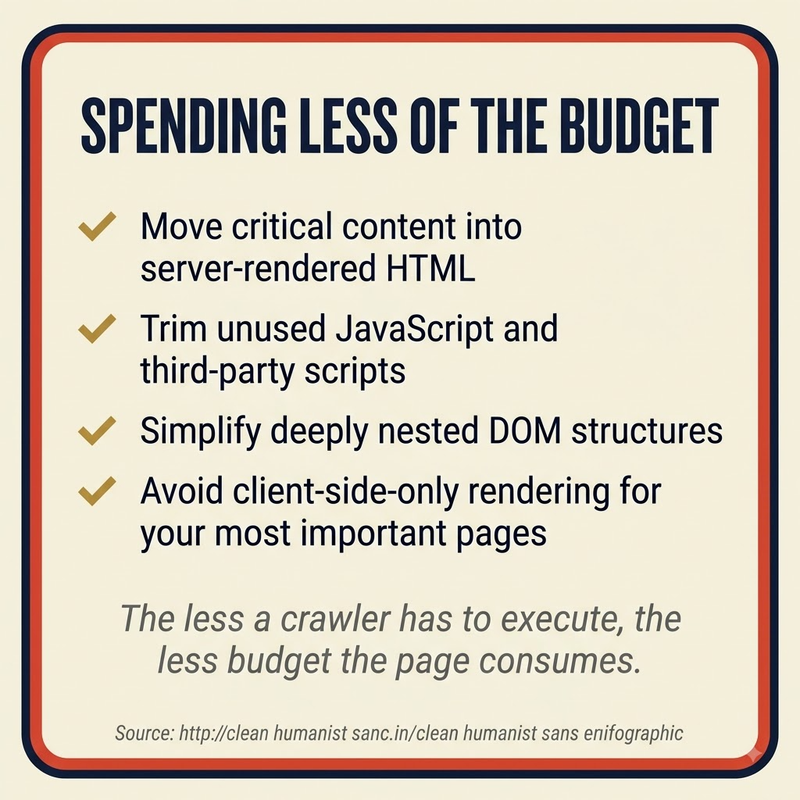
- Use server-side rendering (SSR) or static site generation (SSG) for content that's critical to search visibility, so it's present in the initial HTML response rather than requiring separate JavaScript execution to appear.
- Ensure important internal links use standard <a href> markup rather than JavaScript-only click handlers, since standard links are far more reliably discovered regardless of render timing.
- Minimize unnecessary JavaScript execution for content that doesn't need to be dynamic — static content forced through an unnecessary client-side rendering process adds render burden without a corresponding benefit.
- Test how a page actually renders from a crawler's perspective using tools like Google Search Console's URL Inspection tool, which shows the rendered HTML Google's systems actually captured.
- Monitor indexing timelines for JavaScript-dependent pages specifically, watching for unusually long delays between publishing and full indexing that might indicate render budget constraints are a real factor for that site.
Frequently Asked Questions
Does Google publish a specific numeric render budget for individual sites?
No. Google hasn't published specific numeric render budget figures for individual sites, similar to how it doesn't publish exact crawl budget numbers. Both are described qualitatively, rather than as a disclosed figure a site owner can look up.
Can a small site with light JavaScript usage ignore render budget concerns entirely?
Largely yes. Render budget concerns scale with how JavaScript-dependent a site's critical content and structure actually are. A site using JavaScript minimally, or only for non-critical enhancements, faces far less practical risk.
Does render budget affect mobile and desktop indexing differently?
Google's indexing is primarily mobile-first, meaning the mobile version of a page's rendering is generally the one that matters most for the render budget concept in practice.
How can you tell if render budget delays are actually affecting a specific site's indexing?
Comparing the publish date of JavaScript-dependent content against when it actually appears fully indexed in Search Console, and checking for unusually long gaps, is a practical way to identify potential render budget impact.
Does using a popular JavaScript framework (React, Vue, Angular) automatically create render budget problems?
Not automatically — the framework choice itself matters less than whether the site implements server-side rendering, static generation, or relies entirely on client-side rendering for critical content.
Is render budget a concern for AI search crawlers as well as Google?
Yes, potentially more so — many AI crawlers have historically had more limited JavaScript rendering capability than Google's systems, meaning render-budget-style concerns can be even more pronounced for AI-search visibility on JavaScript-heavy sites.
Can render budget issues cause a page to be indexed with incomplete content?
Yes — if only part of a page's JavaScript successfully renders within the time or resources allocated, Google may index a partial, incomplete version of the page's actual content.
Does improving page speed generally also improve render budget efficiency?
Yes — faster-executing JavaScript and lighter overall page weight reduce the computational resources needed for rendering, which directly supports more efficient and complete render budget usage.
Is render budget the same concept across all search engines, or specific to Google?
The underlying JavaScript-execution resource constraint applies broadly across search engines and AI crawlers that render JavaScript at all. The specific term "render budget" itself though is most commonly used in the context of discussing Google's behavior.
Can a site request more render budget from Google the way it might address other technical issues?
No. There's no mechanism to directly request additional render budget. The practical response is reducing how much critical content depends on JavaScript execution in the first place, which lowers the burden rather than increasing an allocation.


